Ask to include
- Cabinets or panels named by the proposed model
- Receiving cards and power supplies listed on the bill of materials
- The control interface the supplier says is required for that model
- Export packing described for the stated quantity
Factory sourcing support for led video wall
Independent sourcing partner
A led video wall brief has to name the room, the viewing distance, and the cabinet geometry before a factory number means anything. Led Video Wall Sourcing records those open items and sends the same sheet to more than one plant. The desk does not assemble modules and does not publish a warehouse count.
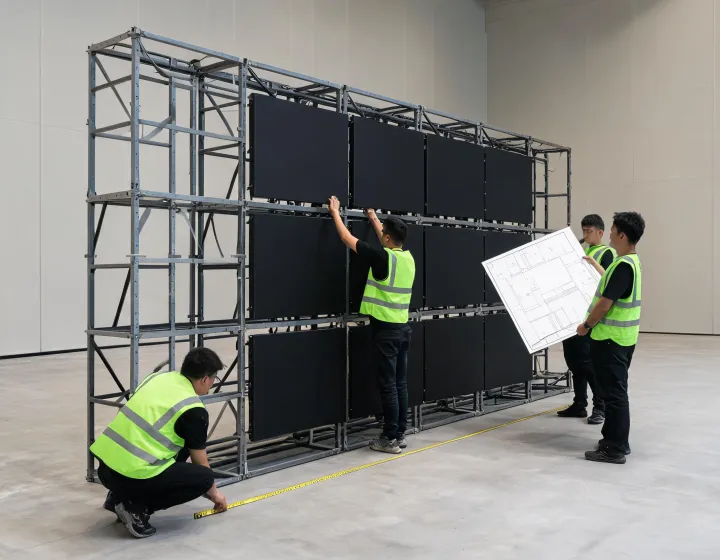
Use this ledger to stop a headline cabinet price from hiding flight cases, spare power supplies, or on-site commissioning. Nothing below is a published rate.
Procurement, engineering, operations, and quality do not need four different walls. They need four question lists that meet on the same model number.
Lock quantity, currency, Incoterm, and the US destination. Ask whether spare modules are priced per cabinet or as a whole-order kit. A target budget stays optional and is not a confirmed factory figure.
Match pixel pitch to the closest viewer, not to a brochure photograph. Record input voltage, phase, and the control interface. A specification deviation belongs in a column next to the requirement, not in a footnote that never gets compared.
Mark service access as front, rear, or both, and the clearance in millimeters. Note ambient temperature and whether the wall runs all day or only for events. Throughput here means how fast a failed module can be swapped, not a production-line rate.
Request a factory acceptance test tied to the proposed cabinets, plus the certificate scope if a UL, ETL, or FCC file is offered. A family datasheet does not transfer those marks to another pitch.
Write the open fields with units before anyone compares sheets: refresh at 1920 Hz or 3840 Hz, an indoor screening band of 600 to 800 nits, an outdoor screening band of 4500 to 5500 nits, IP54 versus IP65, and seam repeatability of 0.1 mm only if the drawing names that tolerance. Rated power belongs in watts per cabinet at a stated nit level, for example 180 W or 450 W. Duty cycle belongs in hours on, for example 14 hours on and 10 hours dark. Noise level, if the room is a studio, is a decibel question, often checked near 25 dB or 40 dB at 1 m. Commissioning scope might be 2 days or 5 days and must say who attends. A spare parts list of 5 percent or 8 percent of modules is a buyer choice, not a default. Preventive maintenance at 6 months or 12 months stays on the supplier sheet. A 2.6 mm pitch and a 3.9 mm pitch are different questions, as are a 500 mm cabinet and a 1000 mm cabinet.
Continue in equipment options, sourcing support, the outdoor workflow, or the procurement brief.
Write the site voltage, frequency, and phase, such as 120/208 V, 60 Hz, three phase, if that is what the room actually has. Ask the supplier to restate the utilities requirement for the exact proposed power supplies. A 100-240 V label on a family sheet is a question, not proof that your panel string is compatible.
Ask for nits, the white-point or test pattern, and whether the figure is calibrated or peak. Outdoor and indoor numbers are not interchangeable. If the test basis is missing, leave the cell blank instead of copying a catalog peak.
Pitch describes diode spacing. It does not set viewing distance by itself, and it does not set the working envelope of the steel. Pair pitch with cabinet millimeters, seam tolerance, and the closest seat.
Only when the quotation names the card, the backup path, and who supplies the processor. A control interface mentioned in marketing copy can be an accessory line. Put it in the included column or the excluded column before you compare totals.
No ratio is stored here. State the spare count you want, or mark it unknown. Consumables such as masks, magnets, and data cables should be listed separately from the spare LED modules.
Send the sheet when the gaps are labeled. A quotation that arrives against a blank pitch is not comparable.
Qualified business buyers
A confirmed benefit may be up to 3%.
Eligibility applies to qualified business buyers and is confirmed after we review your product, quantity, destination, and sourcing requirements.